
- Home
- About Us
- Working Together
- Core Services
- Accountancy
- Audit & Assurance Support
- Bookkeeping
- Corporation Tax
- Creditors Management
- Debtors Management
- Statutory Accounts
- Making Tax Digital (MTD)
- Property Tax
- Self Employed Individuals
- Self-Assessment Returns
- Taxation & Planning
- VAT Returns
- Capital Gains Tax
- Contractors / Freelancers Compliance
- Limited Liability Partnership Compliance
- Financial Management
- Payroll and HRM
- Project Portfolio Management Office
- Digital Marketing
- Accountancy
- Contact Us
Contractors / Freelancers Compliance
- Home
- Core Services
- Accountancy
- Contractors / Freelancers Compliance
UK's Trusted IR35 & Compliance Partner for Contractors & Freelancers
Stress-free IR35 assessments, HMRC & Companies House compliance, 24/7 support and a real-time dashboard, so you can focus on your client work while we handle the paperwork.
- Fixed-fee pricing
- Inside & outside IR35
- IT contractor specialists
What is IR35, and why does it matter?
IR35 (also called the off-payroll working rules) is UK tax law that stops people who work like employees from paying less tax simply because they invoice through their own limited company. If you’re outside IR35, you’re genuinely in business on your own account and can pay yourself tax-efficiently. If you’re inside IR35, you’re treated as an employee for tax, so Income Tax and National Insurance are deducted on your fees, much like PAYE. Since 6 April 2021, medium and large private-sector clients (like public-sector bodies) must decide your status and give you a written Status Determination Statement (SDS). For small clients, the responsibility stays with your own company. Getting it wrong can mean backdated tax, National Insurance, interest and penalties.
Contract Review Service
Clause-by-clause IR35 contract review: substitution, control, mutuality of obligation, right of termination and more, with risk ratings and suggested amendments.
Inside IR35 Support
Qualified bookkeepers and part-qualified accountants command higher salaries every year, squeezing margins on compliance-heavy client work.
Outside IR35 Support
Build the evidence: documented working practices, substitution proof and audit-readiness so your outside IR35 status stands up if HMRC asks.
HMRC Dispute Support
If HMRC opens an enquiry, we prepare your documentation, handle correspondence and represent you throughout.
Ongoing IR35 Monitoring
New contract? New role? Extension? We re-assess status whenever your engagement changes, and the dashboard tracks it per contract.
End-client & Agency Liaison
Received an SDS you disagree with? We help you challenge it, liaising with the end client and agency. Clients have 45 days to respond to a formal challenge.
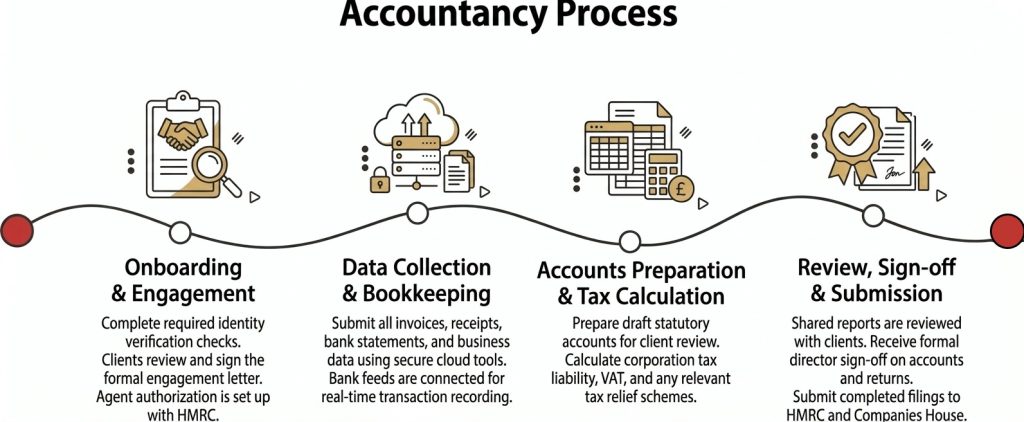
Contractor accounting services UK-wide, from set-up to year-end
One team for your company, your tax, your filings and your IR35 status. Everything a contractor or freelancer needs to stay compliant, in one place.
Company Formation & Registration
Company formation for IT contractors and freelancers, done correctly the first time.
HMRC Compliance
HMRC compliance for contractors: every return filed accurately and on time.
Companies House Compliance
A reliable Companies House filing service so your company stays in good standing.
Bookkeeping & Accounting
Clear, up-to-date books you can rely on for tax, mortgages and business loans.
Payroll & Umbrella Services
Compliant payroll whether you're inside IR35 or paying yourself from your own company.
Tax Planning & Advisory
Legitimate, HMRC-compliant planning that keeps more of what you earn.
Benefits of outsourcing
Outsource your back office to E-Tech and get your time back
You’re paid for your expertise, not your admin. Hand the compliance to specialists.
Save Time
Focus on client work, not paperwork. We take the filings, reminders and chasing off your plate.
Avoid Costly Penalties
Stay ahead of IR35 and HMRC deadlines so surprise fines and backdated bills never land on your doormat.
Access IR35 Specialists
Specialist accounts advisors, not generalists, reviewing your contracts and working practices.
Transparent
Know your exact monthly cost up front. No hidden extras charges, no surprise invoices at year-end.
Scales as you grow
From sole trader to multi-contract limited company, or a team of subcontractors. Add services as you need them.
Peace of Mind
Work with HMRC-recognised professionals who know the rules and keep you on the right side of them.
Why choose us
Why contractors choose us
We’re IR35 specialists first and accountants second, and we work the way independent professionals do.
- Fast turnaround
- Transparent pricing
- Proven track record
- 24/7 customer support
- In-house IR35 specialists
- Secure & GDPR-compliant
- Dedicated account manager
- HMRC-recognised compliant processes
FAQs
Frequently Asked Questions
IR35 (the off-payroll working rules) exist to make sure that contractors who work like employees pay similar Income Tax and National Insurance to employees, even if they work through their own limited company. It applies if you provide your services through an intermediary such as a personal service company (PSC) and, if HMRC looked at the real working relationship with your client, you would be an employee. Most IT contractors working through a limited company need their contracts and working practices checked against the rules.
Status depends on the real working relationship, not the job title or what the contract says. Three key factors are control (who decides how, when and where you work), substitution (whether you can send a suitably skilled replacement) and mutuality of obligation (whether the client must offer, and you must accept, further work). HMRC's CEST tool can help, but it is not the final word, so an expert review of your contract and working practices gives you a much more reliable answer.
Not if you trade as a sole trader. You register with HMRC for Self Assessment instead. You only register with Companies House if you set up a limited company. Many IT contractors choose a limited company because of the tax planning options and liability protection, but it brings extra filing duties such as annual accounts, a confirmation statement and corporation tax returns.
HMRC charges an initial £100 penalty for a late Self Assessment return, even if you owe no tax. After three months, daily penalties of £10 a day can build up to £900. After six months and again after twelve months, a further penalty of 5% of the tax due or £300 (whichever is greater) applies. Late payment penalties and interest are charged separately. Contact us as early as possible and we will help you file and, where appropriate, appeal.
Yes. We check whether you need to register (or would benefit from doing so voluntarily), submit the registration to HMRC, advise on the Flat Rate Scheme versus standard VAT accounting, and prepare and file your VAT returns through Making Tax Digital-compatible software.
HMRC may open an enquiry and ask for contracts, invoices and evidence of how you actually work. If they conclude you were inside IR35, you could face backdated Income Tax and National Insurance, interest and penalties. Our IR35 specialists prepare your documentation, handle correspondence with HMRC and represent you through the dispute, so you are not facing it alone.
Your secure, mobile-friendly dashboard shows your accounts, HMRC and Companies House filing status, upcoming deadlines and an IR35 status tracker for each contract. You can upload and download documents such as contracts, Status Determination Statements and payslips, message your dedicated accountant or IR35 advisor, and receive reminders before deadlines and contract renewals.