
- Home
- About Us
- Working Together
- Core Services
- Accountancy
- Audit & Assurance Support
- Bookkeeping
- Corporation Tax
- Creditors Management
- Debtors Management
- Statutory Accounts
- Making Tax Digital (MTD)
- Property Tax
- Self Employed Individuals
- Self-Assessment Returns
- Taxation & Planning
- VAT Returns
- Capital Gains Tax
- Contractors / Freelancers Compliance
- Limited Liability Partnership Compliance
- Financial Management
- Payroll and HRM
- Project Portfolio Management Office
- Digital Marketing
- Accountancy
- Contact Us
Limited Liability Partnership Compliance
- Home
- Core Services
- Accountancy
- Limited Liability Partnership Compliance
UK’s Trusted Compliance & Back-Office Partner for Partnerships & LLPs
Stress-free formation, HMRC & Companies House compliance, partner-level accounting, 24/7 support and a real-time dashboard — built for firms with more than one name on the letterhead.
- HMRC-recognised agent Authorised to act on your behalf
- ICAEW / ACCA affiliated Qualified, regulated professionals
- 15+ years in business Specialist multi-partner experience
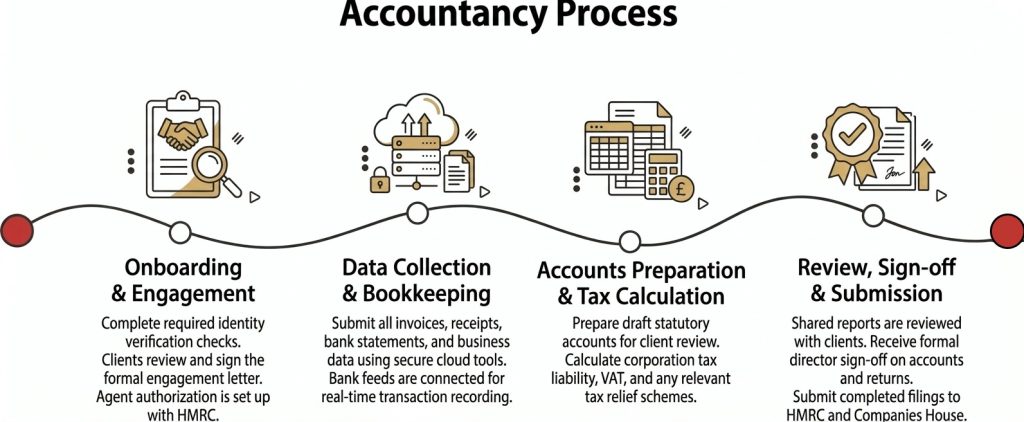
Accounting & compliance built for UK partnerships and LLPs
Whether you are forming a new LLP or running a ten-partner practice, we speak the language of partners, designated members and profit shares — so you don’t have to translate.
Professional services firms
Law, accountancy, architecture and consulting practices needing an LLP accountant who understands professional-services models.
General / traditional partnerships
Partnership tax returns, partner self-assessment and clear records that protect every partner.
Limited liability partnerships
Companies House filings, LLP accounts, designated member duties and HMRC compliance under one roof.
Multi-partner practices & joint ventures
Complex profit allocation, capital accounts and partner drawings handled accurately, every period.
Family-run partnership businesses
Fair, documented profit sharing and tax coordination that keeps family and finances separate.
Partnerships converting to an LLP
Planned conversion from partnership to LLP in the UK, with the tax consequences mapped out first.
Companies House filing for LLPs — accurate, on time, every year
An LLP is a registered entity, which means public filings and statutory duties that a general partnership never faces. We take care of them and keep your designated members protected.
LLP annual statement
Prepared, checked with your members and filed before the deadline — every year, without chasing.
Annual accounts preparation
LLP-specific formats prepared to the correct framework, including guidance on LLP audit requirements and size thresholds.
PSC register maintenance
Persons with Significant Control identified, recorded and kept current in line with Companies House rules.
Member statutory duty support
Clear checklists and reminders for designated member responsibilities in an LLP, including identity verification.
Changes to LLP agreement
Members joining or leaving, name or address changes and other notifications filed promptly.
Dissolution & strike-off support
Where an LLP has reached the end of its life, we manage final accounts, HMRC clearances and the closure process.
Benefits of outsourcing
Why partnerships and LLPs outsource back-office compliance to E‑Tech
Save Time
Focus on clients and practice growth, not paperwork and portal log-ins.
Avoid penalties & errors
Proactive deadline management and double-checked filings.
Specialist access
Advisers who work with partnerships and LLPs every day.
Fixed-fee pricing
Transparent fees agreed in advance. No hidden costs.
Scales with you
Add partners, entities or services without changing provider.
Peace of Mind
HMRC-recognised professionals handling your filings.
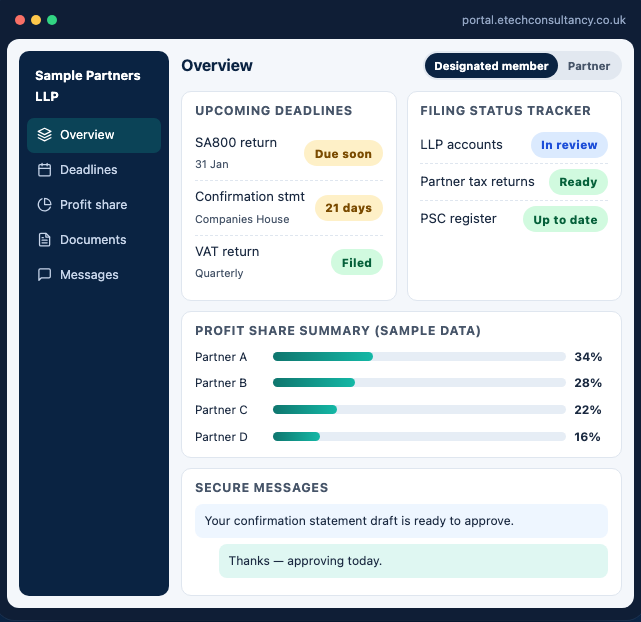
Client dashboard
One secure dashboard for every partner, filing and deadline
See exactly where your partnership or LLP stands — anytime, from anywhere — with role-based access for designated members and individual partners.
- Real-time visibility into filings, deadlines and partner accounts
- Role-based permissions — designated members vs individual partners
- Customisable widgets — deadlines, profit-share summaries, VAT status
- Document centre — LLP agreements, statutory records and accounts
- Filing status tracker — SA800, confirmation statement and accounts
- Secure messaging with your dedicated accountant
- Individual partner logins for personal tax return visibility
- Deadline notifications and reminders by email
Why choose E-Tech Consultancy & Services as your LLP accountant
We are the specialist that understands multi-partner complexity — and treats your firm’s compliance as seriously as you treat your clients’.
Dedicated account manager
One named contact who knows your partnership or LLP inside out.
Profit allocation specialists
Deep experience in multi-partner profit sharing and compliance.
24/7 customer support
Live chat, phone and email whenever you need us.
HMRC-recognised processes
Compliant, documented workflows with clear review steps.
Transparent pricing
Fixed fees. No hidden extras when the deadline gets close.
Fast turnaround
Quick responses on filings and queries, with deadlines tracked for you.
UK-wide remote service
Serving London and professional services firms across the UK online.
Proven track record
Client feedback and case studies from partnerships and LLPs.
Data security & GDPR
Secure, GDPR-compliant systems for sensitive partner and financial data.
FAQs
Frequently Asked Questions
A general partnership is not a separate legal entity: the partners share unlimited, joint and several liability for the firm’s debts. A limited liability partnership (LLP) is a separate legal entity registered at Companies House, and members’ liability is generally limited to the amount they have agreed to contribute. An LLP has extra public filing duties (annual accounts and a confirmation statement), but both structures are taxed transparently, which means profits are taxed on the individual partners or members rather than on the firm itself.
Yes, there are two layers. The partnership or LLP files one partnership tax return (SA800) reporting the firm’s profits and how they are shared. Each individual partner then reports their own share on their personal Self Assessment return. E-Tech prepares both from the same set of figures so they always agree.
Every LLP must have at least two designated members. On top of ordinary member duties, designated members are responsible for the LLP’s statutory filings and compliance: delivering annual accounts and the confirmation statement on time, appointing auditors where an audit is required, keeping the registered office and statutory records up to date, notifying Companies House of changes to members and completing Companies House identity verification. Failures can lead to penalties and, in serious cases, personal consequences.
Profit is shared as set out in your LLP agreement, and by default equally if there is no agreement. The LLP itself does not pay income tax on its profits. Each individual member is taxed as self-employed on their allocated share (income tax and Class 4 National Insurance), whether or not they have drawn the money. Corporate members pay corporation tax on their share, and HMRC’s salaried member rules can treat some LLP members as employees. A clear profit sharing agreement and accurate records are essential.
Yes. We handle the LLP name check and Companies House incorporation, guide you on the LLP agreement (working alongside your solicitor where needed), register the LLP and its members with HMRC, and plan the transfer of contracts, assets and bank accounts. We also review the tax impact, such as capital gains, capital allowances and VAT, before you convert so there are no surprises.
Failing to deliver a confirmation statement on time is an offence, and Companies House can take enforcement action against the LLP and its officers, and may ultimately strike the LLP off the register. Late annual accounts also attract automatic penalties, currently from £150 to £1,500 depending on how late they are, doubling if accounts are late in two successive years. If you have already missed a deadline, file as soon as possible and contact us; we track every date for our clients so it doesn’t happen.
Each partner and designated member gets their own secure login with role-based permissions. Designated members can see and approve statutory filings, deadlines and documents such as the LLP agreement. Individual partners can see their own profit share, drawings and personal tax return progress. You can message your dedicated accountant, upload and download documents, and receive email reminders before every deadline.
Not always. Small LLPs that stay within the size thresholds can usually claim exemption from a statutory audit, while larger LLPs must be audited. The thresholds and conditions change from time to time, so we check them every year as part of your accounts preparation and tell you well before year-end if an audit will be required.
Both offer limited liability and are registered at Companies House. A limited company has directors and shareholders and pays corporation tax on profits, while an LLP has members and its profits are taxed directly on those members as self-employed income. LLPs are popular with professional services firms because of their flexible internal structure and profit sharing, while limited companies suit businesses that want to retain profits or issue shares. We can model both options for your practice.