

Statutory Accounts
- Home
- BPO
- Accountancy
- Statutory Accounts
Statutory accounts preparation, without the year-end bottleneck
Statutory accounts preparation is the process of turning a client’s trial balance into a complete, statutory-compliant set of financial statements — balance sheet, Income Statement , notes and supporting schedules — ready for Companies House filing and HMRC submission. It’s precise, deadline-driven work, and it’s also one of the most predictable pinch points in the UK accounting calendar.
E-Tech Consultancy & Services provides UK accountancy firms with reliable Statutory accounts back office support — a dedicated offshore team trained on UK financial reporting standards, working inside your own accounts production software, delivering statutory accounts your team reviews and signs off with confidence. Accuracy, compliance and timely submission sit at the centre of every file we touch.
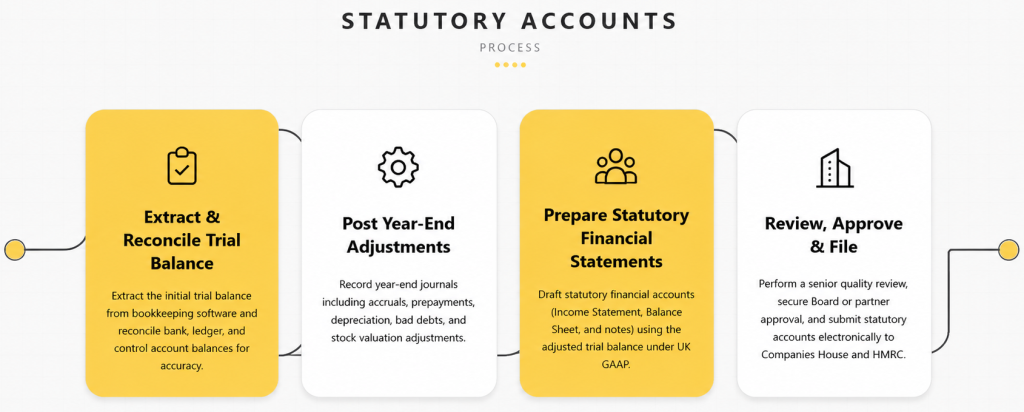
UK accountancy firms outsource year-end accounts for reasons that will sound familiar to most practice partners: a limited pool of qualified Accountants, salary costs that keep rising faster than fees, a filing season that concentrates months of work into a few intense weeks, and clients who expect fast turnaround without any drop in accuracy. Add in the ongoing complexity of FRS 102 and FRS 105 reporting, and Statutory accounts preparation becomes a specialist skill that’s expensive to keep fully staffed in-house, year-round.
What are Statutory accounts?
Definition & purpose
Statutory accounts are the formal financial statements prepared at the end of an accounting period, summarising a business’s financial position and performance. They exist to give owners, directors, lenders and regulators an accurate picture of profitability, assets, liabilities and cash movement.
Statutory compliance
For limited companies, Statutory accounts satisfy Companies House filing requirements and HMRC’s corporation tax obligations. Missing or inaccurate filings carry financial penalties and reputational risk for both the client and the firm that prepared them.
Decision-making & investor confidence
Beyond compliance, well-prepared Statutory accounts give business owners a genuine basis for decisions on investment, funding and growth, and give investors the confidence that the numbers behind a business can be trusted.
Financial transparency
Clear, properly disclosed financial statements build transparency with HMRC, Companies House, shareholders and any third party relying on a business’s reported position.
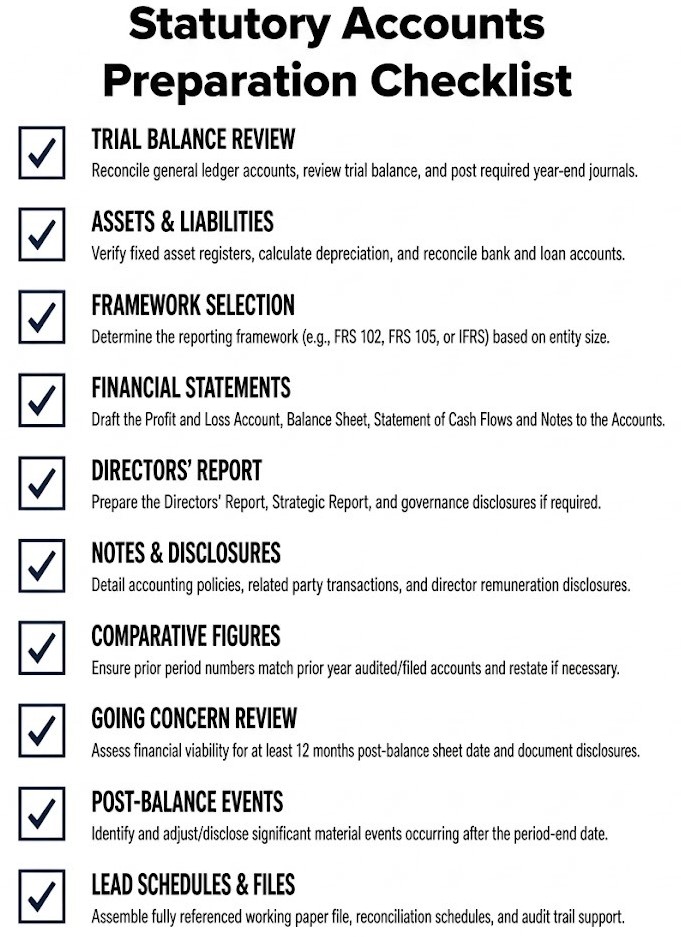
The Full Set
Types of financial statements we prepare
Balance sheet
A snapshot of financial position at year end.
- Purpose: shows solvency and financial strength
- Importance: relied on by lenders, investors and HMRC
- Key components: fixed assets, current assets, liabilities, share capital
Income Statement
Summarises trading performance over the accounting period.
- Revenue: total income generated in the period
- Expenses: cost of sales, overheads and finance costs
- Net profit: the bottom-line measure of business performance
Cash flow statement
Tracks how cash actually moved through the business.
- Operating activities: cash generated from core trading
- Investing activities: capital expenditure and asset disposals
- Financing activities: loans, share issues and repayments
Statement of changes in equity
Explains how shareholders' equity moved during the year.
- Share capital: amounts introduced by shareholders
- Reserves: retained profits and other equity reserves
- Retained earnings: cumulative profit carried forward
Line by Line
Our Statutory accounts back office services
From trial balance to filed accounts, every stage handled or supported.
Year-end accounts preparation
Full statutory accounts prepared from your client's trial balance, ready for review.
Trial balance review
Balances checked for completeness before accounts production begins.
Journal adjustments
Correcting and reclassification journals prepared with a clear audit trail.
Accruals & prepayments
Period-end adjustments calculated so income and costs sit in the right accounting period.
Fixed asset schedules
Asset registers maintained and reconciled to the balance sheet each year end.
Depreciation calculations
Depreciation applied consistently with the client's accounting policy and asset lives.
Financial statement preparation
Balance sheet, Income Statement, notes & disclosures drafted as per required format.
Working papers
Full supporting working papers delivered alongside every set of accounts.
Companies House accounts
Accounts formatted and ready for iXBRL tagging and Companies House filing.
Corporation tax support
Computations and supporting schedules prepared to feed your CT600 process.
IFRS reporting
Support for entities reporting under IFRS where a client's structure requires it.
FRS 102 & FRS 105 compliance
Accounts prepared correctly for the standard your client actually reports under.
Management accounts support
Interim management accounts to keep clients informed ahead of year end.
Financial review assistance
Additional review capacity during peak filing periods, to your quality standard.
Sole trader & partnership accounts
Statutory accounts prepared for sole traders, partnerships and LLPs.
Problems we solve
Why Statutory accounts matter beyond compliance
Statutory accounts satisfy a statutory obligation — Companies House submissions and HMRC requirements sit at the core of why they’re prepared at all — but their value to a client runs well beyond the filing deadline. A properly prepared set of accounts is often the single document a lender, investor or potential buyer will scrutinise most closely, making it central to funding opportunities, tax planning and strategic decision-making.
For accountancy firms, reliable Statutory accounts preparation supports business performance measurement for clients, builds investor confidence, and underpins the financial transparency that keeps a client relationship healthy over the long term. When a firm can consistently deliver accurate, well-presented accounts on time, that reliability becomes part of its reputation — and a real driver of long-term business growth, for the firm as much as the client.
Our Case for Trust
Why UK accountancy firms choose E-Tech Consultancy
Experienced professionals
Experience Accountants with industry expertise , not generalists.
Dedicated offshore teams
A named team assigned to your practice, not a shared rotating pool.
UK accounting expertise
Deep familiarity with FRS 102, FRS 105 and Companies House requirements.
Affordable outsourcing solutions
Transparent pricing that's a fraction of an in-house specialist hire.
Strict confidentiality
Signed NDAs and controlled access protect every client file.
Secure cloud-based systems
Encrypted, permissioned file transfer as standard on every engagement.
Flexible engagement models
Scale a single busy-season overflow or a full outsourced function.
Fast turnaround
Agreed SLAs keep files moving to your filing deadline, not ours.
Quality assurance process
Every file passes a second reviewer before it's returned to you.
Transparent communication
Direct access to your accounts team during UK working hours.
Industry best practice
Standardised, documented processes across every client file.
Technology-driven workflows
Capacity and process built to grow with your practice.
The Year-End Reality
Common challenges UK firms face — and our solution
| Challenge | Business impact | Our solution |
|---|---|---|
| Year-end workload peaks | Accounts pile up in the same few weeks every year | Extra capacity brought in exactly when volume spikes |
| Staff shortages | Vacant accounts-preparer roles slow the whole pipeline | Trained preparers assigned within days, not months |
| Recruitment costs | Hiring and training a qualified preparer is slow and expensive | Access to trained professionals with no recruitment cost |
| Tight filing deadlines | Companies House and HMRC deadlines leave no room for delay | Agreed turnaround SLAs built around your filing calendar |
| Manual processes | Spreadsheet-heavy preparation is slow and error-prone | Workflow built around your accounts production software |
| Data inconsistencies | Poor trial balance quality delays the whole file | Trial balance review flags issues before drafting starts |
| Compliance risks | Incorrect FRS application creates refiling and penalty risk | Preparers trained specifically on FRS 102 and FRS 105 |
| Client growth | A growing client bank outpaces in-house preparation capacity | Team size scales with the number of files you take on |
| Complex accounting standards | Keeping every preparer current on standards is time-consuming | Continuous training keeps our team current on UK GAAP |
| Multi-client management | Tracking dozens of files at different stages gets unwieldy | Structured file tracking and status reporting per client |
| High operational costs | In-house preparation carries salary, software and office cost | Offshore delivery reduces preparation cost significantly |
| Software compatibility | Migrating between platforms takes specialist time | Working expertise across CaseWare, VT, TaxCalc and more |
FAQs
Frequently Asked Questions
The formal set of financial statements — balance sheet, Income Statement and notes — prepared at year end for statutory filing and business reporting.
It gives your practice specialist accounts preparation capacity that flexes with client volume, without the cost of a full-time in-house hire.
Yes, accounts are formatted and prepared ready for iXBRL tagging and Companies House filing.
Yes, we prepare accounts under FRS 102, FRS 105 and IFRS depending on the client's reporting requirement.
We work directly in TaxCalc, Xero, QuickBooks, Sage, FreeAgent, Excel, CaseWare and VT Statutory Accounts.
Data is exchanged through encrypted, permission-controlled channels, protected by signed NDAs and access controls.
Yes, a dedicated team scales across your full client bank as file volume grows.
Yes, our Virtual CFO services give you strategic financial leadership, investor and board reporting, funding support and growth strategy without the cost of a full-time in-house CFO.
We prepare accounts across retail, construction, professional services, technology, charities and more, for sole traders through to limited companies.
Yes, delivery windows are built around your Companies House and HMRC filing deadlines.