
Making Tax Digital Services UK for Accountancy Practices & Businesses
Making Tax Digital (MTD) is HMRC’s programme to move UK tax records and submissions onto digital, real-time systems. E-Tech Consultancy & Services is a UK-based MTD specialist, helping accountancy practices and business finance teams choose the right software, migrate data cleanly, and stay compliant as HMRC’s rules continue to evolve.
Your dedicated partner for Making Tax Digital compliance — from first assessment through to ongoing, year-round support.

What Is Making Tax Digital and Why Does It Matter?
Making Tax Digital is HMRC’s long-term initiative to digitise the UK tax system, replacing manual and paper-based record-keeping with digital tools that connect directly to HMRC. The goal is a tax system that is more accurate, more efficient, and easier for both taxpayers and HMRC to manage in real time.
Why MTD Matters Now
- HMRC's direction of travel is digital-first — manual, non-digital record-keeping is being phased out across every major tax stream.
- Digital records reduce manual entry errors, one of the most common causes of incorrect returns and HMRC enquiries.
- Real-time, always-current records give practices and business owners genuine visibility of tax position, not just a once-a-year snapshot.
- Early, well-planned adoption avoids the disruption, penalty risk, and last-minute software scramble that comes with leaving compliance to the deadline.
How E-Tech Supports Your Making Tax Digital Transition
We work across every stage of MTD compliance for accountancy firms and businesses — not just the initial software switch. Our MTD compliance services cover:
Digital Record-Keeping
We assess your current record-keeping and recommend MTD-compatible software suited to your size, budget, and workflow.
Cloud Accounting Integration
Hands-on setup and integration for Xero, QuickBooks, Sage, and other leading cloud accounting platforms.
API & Bridging Software
For businesses keeping existing spreadsheets or legacy systems, we implement bridging software that connects them to HMRC digitally.
MTD Transition Strategy
For accountancy firms, we design a phased rollout plan across your client bank that minimises disruption to fee-earning work.
Staff Training & Client Onboarding
Practical training for your team and clear communication materials to bring clients along with confidence.
Ongoing Compliance Monitoring
MTD doesn’t end at go-live. We provide ongoing monitoring and support as thresholds, rules, and software requirements evolve.
MTD Guide for Businesses
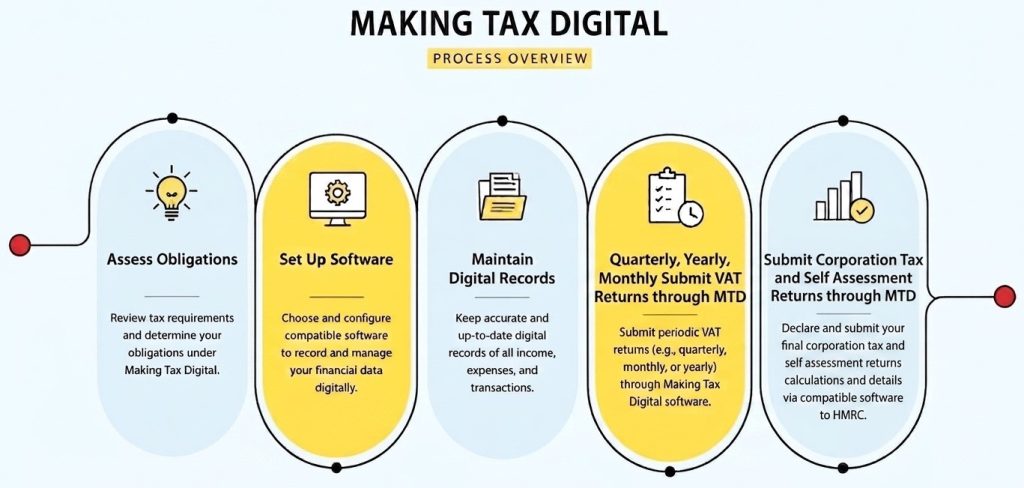
Step-by-Step Guide to Becoming MTD Compliant
Becoming MTD-compliant is a manageable project once it’s broken into clear stages. This is the process we follow with practices and businesses:
Assess your current record-keeping
Review how records are currently kept — spreadsheets, paper, or existing software — and identify gaps against MTD requirements.
Choose MTD-compatible software
Select software that fits your business or practice, whether that's a full cloud accounting platform or bridging software for existing systems.
Migrate and test your data
Move historical and current records into the new system and test submissions before you rely on them for live filings.
Train your team and clients
Make sure staff — and, for practices, clients — understand the new process and know where to go for support.
Go live and submit digitally
Begin submitting through MTD-compatible software, with a clear point of contact if anything needs troubleshooting.
Monitor and review
Check submissions are going through correctly and revisit your setup as your business grows or MTD rules change.
MTD Readiness Checklist
Use this quick MTD checklist to self-assess where your practice or business currently stands:
- I know which MTD rules apply to my business or clients, and from what date.
- My records are currently kept digitally, not on paper or in disconnected spreadsheets.
- My software is confirmed as HMRC-recognised and MTD-compatible.
- I have a plan for migrating historical data without losing accuracy.
- My team — and clients, if I run a practice — have had basic training on the new process.
- I have a process for reviewing submissions before and after they go to HMRC.
- I know who to contact if something goes wrong with a submission.

Why Choose E-Tech Consultancy & Services
MTD compliance touches your software, your processes, and your people. We work across all three, as a dedicated Making Tax Digital services partner rather than a generic IT provider.
- UK-based expertise
Our team works exclusively within UK tax and accountancy regulation, so advice reflects how HMRC’s rules actually apply in practice.
- Dedicated accountancy-sector focus
We specialise in accountancy practices and the businesses they serve — not generic IT support.
- Tailored implementation
No fixed packages — every rollout is built around your existing systems, team size, and client base.
- Ongoing support, not a one-off setup
We stay involved after go-live, so compliance holds up as rules and thresholds change.
- Technology-agnostic advice
We recommend the right MTD software solutions for you, not the platform we’re paid to resell.
- Regulatory awareness
We track HMRC’s Making Tax Digital timetable and thresholds, so you don’t have to.
HMRC's Making Tax Digital Regulations
MTD is a legal requirement, not an optional upgrade. Under HMRC’s Making Tax Digital regulations, businesses and individuals within scope must keep digital records and submit information to HMRC using MTD-compatible software, rather than typing figures manually into HMRC’s online portal. MTD is being introduced in phases, and each tax stream affected by MTD has its own scope, thresholds, and timetable:
- VAT: VAT-registered businesses have been within MTD since 2022, regardless of turnover.
- Income Tax Self Assessment: being phased in for sole traders and landlords above set income thresholds, starting April 2026.
FAQs
Frequently Asked Questions
Making Tax Digital (MTD) is HMRC's initiative requiring businesses and individuals to keep digital records and submit tax information using MTD-compatible software, rather than filing manually through HMRC's online portal.
Yes. MTD is a legal requirement for those within its scope, introduced in phases across VAT and Income Tax Self Assessment. Requirements and start dates vary by tax stream and income level, so it's worth confirming your specific position with HMRC or a qualified adviser.
MTD for Income Tax Self Assessment is being phased in for sole traders and landlords based on qualifying income, with the threshold reducing over time. If you're unsure whether or when it applies to you, we can help you check your position.
Start with the MTD readiness checklist above. If you're keeping digital records in HMRC-recognised software, have a data migration plan, and your team is trained, you're in good shape. If any of that is missing, it's worth getting a proper assessment before a deadline forces the issue.
It depends on the size of your practice or business and the state of your current records, but most straightforward transitions can be planned and completed within a few weeks. Practices migrating a large client bank typically plan a phased rollout over a longer period.