
Capital Gains Tax
- Home
- BPO
- Accountancy
- Capital Gains Tax
What Is Capital Gains Tax?
Capital Gains Tax (CGT) is charged on the profit — or chargeable gain — made when a person disposes of an asset that has increased in value. It is the gain that is taxed, not the total amount received, and liability typically arises on the disposal of assets such as residential and buy-to-let property, shares and investment portfolios, business assets, and increasingly, cryptoassets.
A disposal can mean a sale, but it can also include gifting an asset, exchanging it, or transferring ownership in certain circumstances such as divorce settlements. Where the disposal proceeds (after allowable costs) exceed the acquisition cost, a chargeable gain arises. Where they fall short, the result is an allowable loss, which can often be set against other gains in the same tax year or carried forward to reduce future CGT liability.
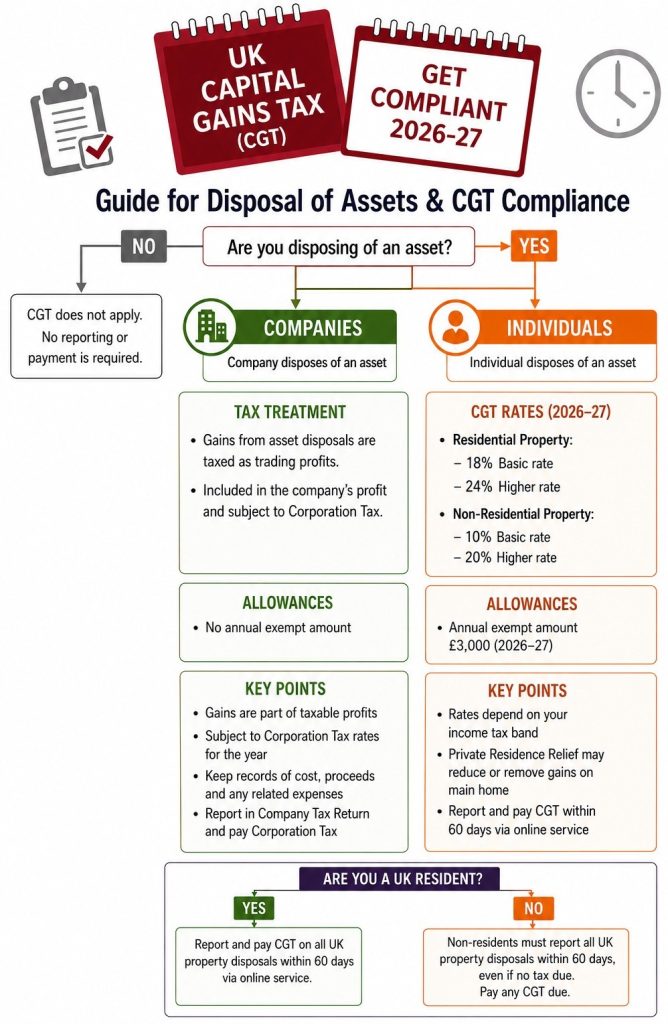
CGT is primarily a tax on individuals: it applies to sole traders, partners, trustees and personal representatives administering an estate. Companies do not pay Capital Gains Tax on disposals — their gains are instead brought into account under Corporation Tax — which is an important distinction accountants must apply correctly when advising incorporated versus unincorporated clients.

Benefits of Outsourcing CGT
Time Savings During Peak Season
Outsource CGT calculation service for accountants during the December–January Self-Assessment crunch and property transaction spikes.
Access to Specialists Without Overheads
Gain dedicated CGT expertise without the cost, recruitment time or training burden of building an in-house specialist function.
Reduced Risk of Costly Errors
Specialist review reduces the likelihood of miscalculations that lead to HMRC enquiries, penalties or client disputes.
Scalable Capacity
Flex volume up or down with client demand, avoiding fixed staffing costs tied to seasonal workload swings.
Faster Turnaround for Time-Sensitive Filings
Meet the 60-day CGT property reporting deadline reliably, even when several client disposals land in the same window.
Focus on Higher-Value Advisory Work
Free your qualified staff from repetitive computation work so they can focus on client relationships and advisory services.
Cost Efficiency
Outsourced tax services UK provide specialist-level output without the fixed cost of a full-time in-house CGT specialist salary.
Confidentiality & Data Security
Client data is handled through GDPR-compliant, secure processes at every stage of the engagement.
Why Choose Us
Dedicated UK CGT Specialists
We focuse on Capital Gains Tax, maintaining current knowledge of HMRC guidance and each year's Finance Act changes.
End-to-End Service
From initial data gathering through to computation and SA108 preparation-ready output, we manage the full workflow.
Clear Turnaround SLAs
Agreed service levels give your firm certainty over delivery timeframes, particularly for 60-day property reporting cases.
White-Label Outsourcing
Our involvement stays behind the scenes — your clients see only your firm, preserving the relationship you have built with them.
Transparent, Flexible Pricing
Per-case, retainer or volume-based pricing models are available, agreed upfront with no hidden costs.
A Single Point of Contact
A dedicated account manager coordinates your firm's cases, so you are never chasing a different contact for every query.
Fields and Aspects of Capital Gains Tax We Cover
Residential Property Disposals
Full computation and preparation support for the 60-day CGT property return, including allowable costs, Private Residence Relief apportionment, and completion-date deadline tracking so nothing is filed late.
Buy-to-Let & Additional Properties
Second homes and investment property disposals, with allowable cost and relief review, including improvement expenditure, letting history, and correct treatment where a property has changed use during ownership.
Shares & Investment Portfolios
Share matching and pooling under the Section 104 holding rules, covering multiple acquisitions, bed-and-breakfasting restrictions, and disposals across mixed portfolios and platforms.
Business Asset Disposals
Computation of gains on the sale or closure of a business, with a full assessment of Business Asset Disposal Relief eligibility and the qualifying conditions that must be met to secure it.
Cryptoasset Disposals
CGT treatment of cryptocurrency and token disposals in line with HMRC guidance, including staking, swaps, and disposals across multiple wallets or exchanges.
Gifts of Assets
Valuation and Gift Hold-Over Relief calculations for gifted business and personal assets, including market-value disposals between connected persons and the conditions relief depends on.
Trust & Estate CGT
Computations for trustees and personal representatives administering estates, including gains arising during administration and the interaction between CGT and the estate's other tax obligations.
Non-UK Resident CGT
Non-Resident Capital Gains Tax on UK property and other UK assets, including rebasing calculations and the specific reporting obligations that apply to overseas-resident disposals.
Divorce & Separation Transfers
CGT implications of asset transfers between separating spouses and civil partners, including the no-gain/no-loss window and timing considerations that affect the final tax position.
Loss Relief Tracking
Calculation and carry-forward tracking of allowable losses across tax years, ensuring historic losses are correctly claimed and offset against current or future chargeable gains.
Why Accurate CGT Calculation Matters
Getting a CGT computation wrong carries real consequences. HMRC can charge penalties and interest on late or incorrect payments, and repeated errors can trigger closer scrutiny of a firm’s wider client base. Beyond the direct financial cost, mistakes damage client trust and expose the accountancy firm’s own professional reputation — often the hardest cost to recover from.
Time pressure compounds the risk. UK residents disposing of residential property with a CGT liability must report and pay within 60 days of completion under HMRC’s UK Property Reporting service — a much tighter window than the annual Self-Assessment cycle, and one that leaves little room for recalculation if the first pass is wrong.
Several factors routinely add complexity to CGT work, including:
- Multiple disposals within the same tax year, each interacting with the Annual Exempt Amount and available reliefs
- Jointly-owned and mixed-use properties, where apportionment between owners and between residential/non-residential use must be calculated correctly
- Non-resident clients disposing of UK property or assets, bringing Non-Resident Capital Gains Tax rules into play
- Trust and estate CGT, with its own rates, exemptions and reporting obligations
- Share pooling and matching rules under the Section 104 holding, which govern how disposals from a mixed share portfolio are matched to acquisition costs
- Cryptoasset disposals, an increasingly common but often misunderstood area of CGT exposure
Our Process: How Outsourcing Works
1 - Initial Consultation & Scope Agreement
We discuss your firm’s requirements, typical case types and volumes, and agree the engagement model and SLAs upfront.
2 - Secure Data Submission
Your team submits client and disposal information through a secure, GDPR-compliant portal — no unsecured email attachments.
3 - Computation & Specialist Review
Our CGT specialists prepare the calculation and apply a second-review quality check before anything is returned to you.
4 - Quality-Checked Output Delivered
You receive a clear, reviewed computation in your firm’s preferred format, ready for your records or client review.
5 - Filing Preparation Support
We support preparation of SA108 supplementary pages or the 60-day property return, so your team can file with confidence.
6 - Ongoing Support & Query Resolution
Our account manager remains available for follow-up queries, HMRC correspondence questions, or future cases.
FAQs
Frequently Asked Questions
UK residents who dispose of residential property with a CGT liability must report and pay via HMRC's UK Property Reporting service within 60 days of completion. Missing this deadline can trigger penalties and interest, which is why many firms outsource the calculation to ensure it is completed accurately and on time.
Yes. Outsourcing CGT calculations to a specialist provider is well established among UK accountancy firms, provided the provider operates under appropriate confidentiality, data protection and quality-control standards, as E-Tech does.
Yes. All client data is handled through GDPR-compliant processes, secure portal submission, and confidentiality agreements, so your firm retains full control over how client information is used and stored.
Turnaround times depend on case complexity and are agreed upfront via clear SLAs, with expedited options available for time-sensitive filings such as the 60-day property return.
Yes. We calculate Non-Resident Capital Gains Tax (NRCGT) for clients disposing of UK land, property or certain other UK assets while resident overseas.
No. Our service operates on a white-label basis — all output is prepared for your firm's own use and branding, so your client relationship remains entirely yours.
Typically we need acquisition and disposal details, dates, costs, improvement expenditure, relevant relief claims, and ownership structure. We provide a simple data-gathering checklist to make submission straightforward.
Yes. Our specialists monitor each Budget, Finance Act and HMRC guidance update on an ongoing basis, so every calculation reflects the rates and allowances in force at the relevant disposal date.
Capital Gains Tax in the UK is primarily governed by the Taxation of Chargeable Gains Act 1992 (TCGA 1992), as amended annually by successive Finance Acts, alongside HMRC guidance and case law.
Depending on circumstances, reliefs such as Private Residence Relief, Business Asset Disposal Relief, Gift Hold-Over Relief, Rollover Relief and Incorporation Relief may apply. We assess eligibility for each relief as part of every calculation.