
Self Assessment Returns
- Home
- BPO
- Accountancy
- Self Assessment Returns
Self Assessment Tax Return Outsourcing for UK Accountancy Firms
E-Tech Consultancy & Services provides accurate, secure and HMRC-compliant Self Assessment back-office support, helping UK accountancy firms, tax advisers and bookkeeping practices manage tax season with confidence — without the recruitment costs or capacity strain.
From SA100 individual returns to SA800 partnerships and SA900 trusts, our UK-trained tax specialists work as an extension of your team, giving you the capacity to onboard more clients while protecting the quality your practice is known for.

Our Services
Our Self-Assessment Back-Office Services
E-Tech Consultancy & Services delivers a full suite of Self Assessment Support for Accountants, covering every income type and return category so your firm can outsource with confidence.
SA100 Individual Tax Return Preparation
Full preparation of individual Income Tax Return filings, incorporating all income sources, reliefs and allowances, ready for HMRC submission.
SA800 Partnership Tax
Returns
Accurate SA800 Partnership Return preparation, including partner profit-share allocations and supporting partnership statements.
SA900 Trust & Estate Tax
Returns
Specialist support for executors and trustees, covering trust income, capital distributions and beneficiary reporting.
Personal Tax Computations
Detailed Tax Computation preparation reconciling all income streams against reliefs and allowances to produce an accurate final liability.
Capital Gains Tax Calculations
Precise Capital Gains Tax workings for property, share and asset disposals, losses and the 60-day residential property reporting rules.
Rental Income Reporting
Full Property Income schedules for UK and overseas landlords, covering allowable expenses and mortgage interest restrictions.
Self-Employment Income Reporting
Complete Self-Employment Income accounts and tax adjustments for sole traders, freelancers and consultants, including capital allowances.
Dividend Income Reporting
Accurate calculations for company directors and investors, applying the current dividend allowance and correct tax bands.
Foreign Income Reporting
Foreign Income declarations covering overseas employment, property, pensions and investments, with double taxation relief.
Employment Income Reconciliation
Reconciliation against P60s, P11Ds and payroll records to ensure benefits-in-kind and expenses are correctly reported.
CIS Tax Calculations
CIS Tax reconciliation for construction subcontractors, matching deductions suffered against liability to identify repayments due.
Student Loan Calculations
Accurate Student Loan Repayment calculations across all plan types, integrated into the overall tax computation.
Child Benefit Charge Calculations
High Income Child Benefit Charge workings for clients affected by rising adjusted net income, avoiding unexpected under- or over-payments.
HMRC Online Filing Support
Submission support through HMRC Online Filing and leading commercial software, ready for authorisation and filing.
Tax Planning Assistance
Supporting analysis to help your client-facing team identify Personal Tax Planning opportunities such as allowance optimisation.
Self-Assessment Compliance & HMRC Filings
HMRC Self-Assessment Registration
New taxpayers must register with HMRC before they can file, establishing their obligation to complete an annual return and starting the compliance clock.
SA302 Tax Calculation
The SA302 Tax Calculation confirms HMRC's assessment of the return and is frequently required by lenders for mortgage applications, making accuracy essential beyond compliance alone.
Unique Taxpayer Reference (UTR)
The UTR is the 10-digit identifier HMRC uses to track an individual's or partnership's tax affairs — every return, payment and piece of correspondence is linked to it.
HMRC Online Submission
Returns are filed digitally via HMRC-recognised software, with instant acknowledgement and audit trail — a workflow we manage end-to-end using our clients' preferred systems.
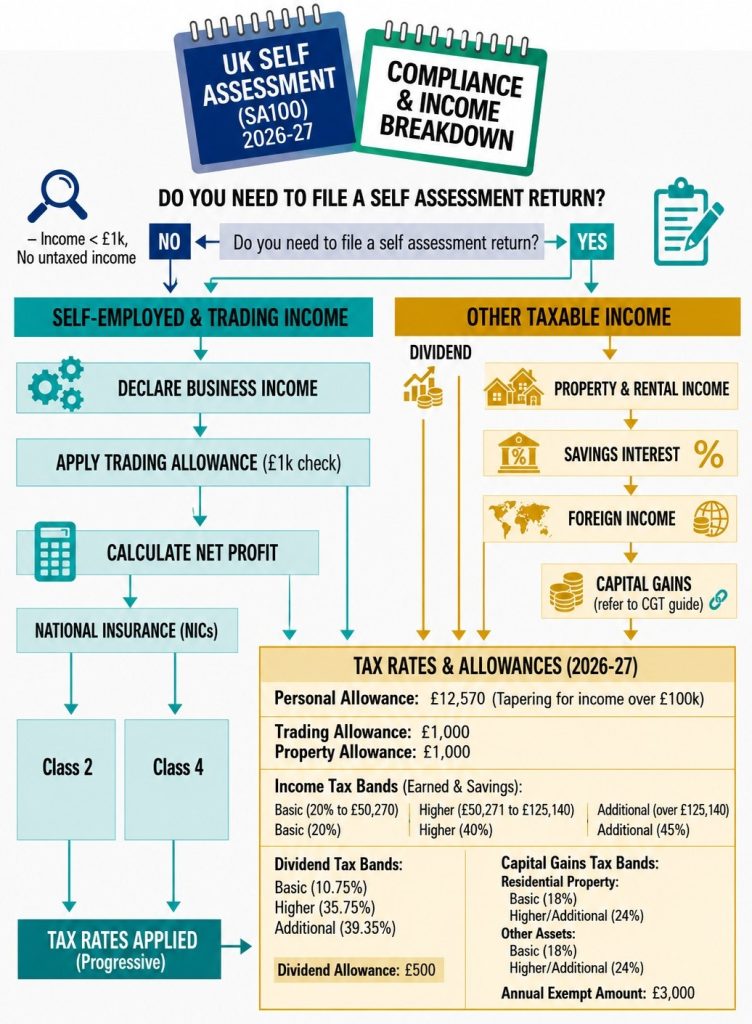
SA100, SA800 & SA900 Returns
Each entity type files a different return: the SA100 for individuals, the SA800 Partnership Return for business partnerships, and the SA900 Trust & Estate Return for trustees and personal representatives.
Our Standards
Key Attributes of Professional Self-Assessment Services
Accuracy
Every computation is checked against source documents before it reaches you.
HMRC Compliance
Returns are prepared to current HMRC rules, reliefs and reporting formats.
Confidentiality
Client data is handled under strict confidentiality agreements and access controls.
Timeliness
Agreed turnaround times keep your firm ahead of internal and HMRC deadlines.
Technical Expertise
Specialists trained specifically in UK personal tax legislation and practice.
Tax Efficiency
Reliefs and allowances are identified and applied wherever legitimately available.
Data Security
Encrypted transfer, secure portals and restricted-access systems protect every file.
Audit Readiness
Organised working papers make HMRC enquiries and internal reviews straightforward.
Transparent Reporting
Clear status updates and query logs keep you informed throughout preparation.
Quality Assurance
A structured review process catches inconsistencies before submission.
Cloud-Based Work
Work is managed through the cloud platforms your firm already uses.
Personalised Support
A named team gets to know your client base, systems and preferences.
The Business Case
Benefits of Outsourcing Self-Assessment Services
Reduced Operational Costs
Avoid the salary, training and overhead costs of building an in-house seasonal tax team.
Access to Professionals
We prepare hundreds of returns each season across every income type.
Faster Turnaround
Dedicated resourcing means returns move through preparation and review more quickly.
Better Compliance
Consistent, HMRC-aligned processes reduce the risk of penalties and enquiries.
Improved Profitability
Lower delivery costs per return improve margins on compliance work.
Dedicated Teams
A consistent team learns your firm's clients, preferences and systems over time.
Scalable Support
Flex capacity up for January and down for the rest of the year, on demand.
Reduced Recruitment Costs
Eliminate the cost and delay of hiring temporary tax season staff.
Enhanced Client Satisfaction
Faster, more accurate filings strengthen client trust and retention.
Business Continuity
Reduce reliance on individual staff members during peak season absences.
Improved Accuracy
Structured quality assurance reduces rework and amendment risk.
Flexible Resource Allocation
Redeploy your in-house team to advisory and higher-value work.
Technology Expertise
Benefit from teams already fluent in the leading UK tax and accounting software.
More Advisory Time
Free up partner and senior staff time for planning and client strategy conversations.
Peace of Mind
A trusted back-office partner managing deadlines lets you focus on running your firm.
Bigger Picture
Why Self-Assessment Compliance Is Important
Avoiding HMRC penalties and meeting statutory obligations protects both your clients and your firm’s professional standing. Accurate tax calculations ensure liabilities are neither over- nor understated, while correctly claiming legitimate Tax Relief protects client cash flow without crossing into non-compliance.
Maintaining thorough financial records supports every future filing, mortgage application and HMRC query, and underpins better Personal Tax Planning conversations with clients throughout the year
Key Dates
Self-Assessment Deadlines Your Clients Cannot Miss
| Requirement | Deadline | Importance |
|---|---|---|
| Self-Assessment Registration | 5 October 2026 | Establishes the obligation to file; late registration can still trigger penalties if tax is unpaid. |
| Paper Tax Return Deadline | 31 October 2026 | Final date for paper SA100/SA800/SA900 submissions. |
| Online Tax Return Deadline | 31 January 2027 | Final date for online filing; the deadline most firms work towards. |
| Balancing Payment Deadline | 31 January 2027 | Remaining tax for 2025/26 falls due alongside the first payment on account. |
| First Payment on Account | 31 January 2027 | Advance payment towards the 2026/27 tax bill where applicable. |
| Second Payment on Account | 31 July 2027 | Second advance instalment towards the following year's liability. |
| Record Retention | Minimum 22 months from tax year end | Records must be available if HMRC opens an enquiry. |
| HMRC Amendments | Within 12 months of the filing deadline | Window to correct errors without formal disclosure procedures. |
The E-Tech Difference
Why Choose E-Tech Consultancy & Services
Experienced UK Tax Professionals
Our team is trained specifically in UK personal tax rules, not generic international tax practice.
Fast Turnaround
Defined service levels keep your firm ahead of the internal review timelines and HMRC deadlines.
Dedicated Teams
You work with a consistent team rather than a rotating pool, building familiarity with your clients and preferences season after season.
Flexible Engagement Models
Choose per-return pricing, dedicated resourcing, or seasonal overflow support to match your firm's needs.
Affordable Outsourcing Solutions
Transparent, competitive pricing models let firms scale cost-effectively without compromising on quality.
Transparent Communication
Regular status updates and a single point of contact keep every engagement visible and predictable.
Secure Cloud Infrastructure
Encrypted document exchange and access-controlled systems keep client data protected throughout preparation.
Scalable Resources
Capacity expands ahead of January and contracts afterwards, so you only pay for what you need.
HMRC Compliance Expertise
We track legislative and HMRC process changes continuously, so your returns stay current.
Latest Tax Software Expertise
Hands-on proficiency in TaxCalc, Xero, QuickBooks, Sage, FreeAgent and Excel-based workflows.
Strong Quality Assurance
Every return passes through structured review before it reaches you, reducing rework and risk.
Client-Focused Service
Every return is prepared with your client relationship — and your firm's reputation — front of mind.
FAQs
Frequently Asked Questions
It is the annual return HMRC uses to collect Income Tax and National Insurance from individuals whose tax is not fully deducted through PAYE, covering income such as self-employment, property, dividends and capital gains.
Sole traders, partners, company directors with untaxed income, landlords, individuals with significant dividend or savings income, those liable for Capital Gains Tax, and anyone affected by the High Income Child Benefit Charge.
The SA100 is the main Self-Assessment tax return form used by individuals to report all sources of income, gains, reliefs and allowances for a tax year.
Yes, we prepare full SA800 Partnership Returns, including partner profit allocations and supporting partnership statements.
Yes, our team supports SA900 Trust & Estate Return preparation for trustees and personal representatives.
Yes, including property, share and asset disposals, reliefs, losses and the 60-day residential property reporting requirement.
Yes, we prepare detailed Property Income schedules and Foreign Income declarations, including double taxation relief where applicable.
Yes, our teams are structured to handle high volumes across a firm's full client base, particularly during peak season.
Yes, alongside firm partnerships we support sole traders, landlords, contractors and high-net-worth individuals directly, subject to appropriate professional referral arrangements.
All data is handled through encrypted portals and access-controlled systems, backed by confidentiality agreements and GDPR-aligned processes.
We work within TaxCalc, Xero, QuickBooks, Sage, FreeAgent and Excel-based workflows, integrating with the systems your firm already uses.
Yes, scalable capacity is our core strength, allowing firms to expand resourcing ahead of the January deadline and scale back afterwards.
Yes, clients are assigned a consistent, named team rather than a rotating pool of preparers.
Yes, we support correspondence and supporting workings for HMRC queries, penalty notices and enquiries.
Typically P60s/P11Ds, self-employment records, rental income and expense summaries, dividend vouchers, capital gains records and prior-year returns, tailored to each client's circumstances.
Turnaround times are agreed at engagement stage and typically range from a few days for straightforward returns to longer for complex, multi-source cases.
We offer per-return pricing, dedicated resource models and seasonal overflow packages, so firms can choose the structure that fits their volumes and budget.
No — we work as your back office. Client relationships, advice and communication remain entirely with your firm; our work is never client-facing unless you request otherwise.