
VAT Returns
- Home
- BPO
- Accountancy
- VAT Returns
Accurate, MTD-Compliant Back-Office VAT Services for Accountants & Businesses
E-Tech Consultancy & Services provides secure outsourced VAT returns for UK chartered accountancy firms, bookkeeping practices, SMEs and limited companies — delivering accurate VAT calculations, on-time HMRC VAT filing, and full Making Tax Digital compliance.
Cut VAT processing costs by up to 60%, reclaim capacity during your busiest filing periods, and hand VAT compliance to a dedicated offshore team of UK-trained VAT specialists — without ever losing oversight of your client relationships.
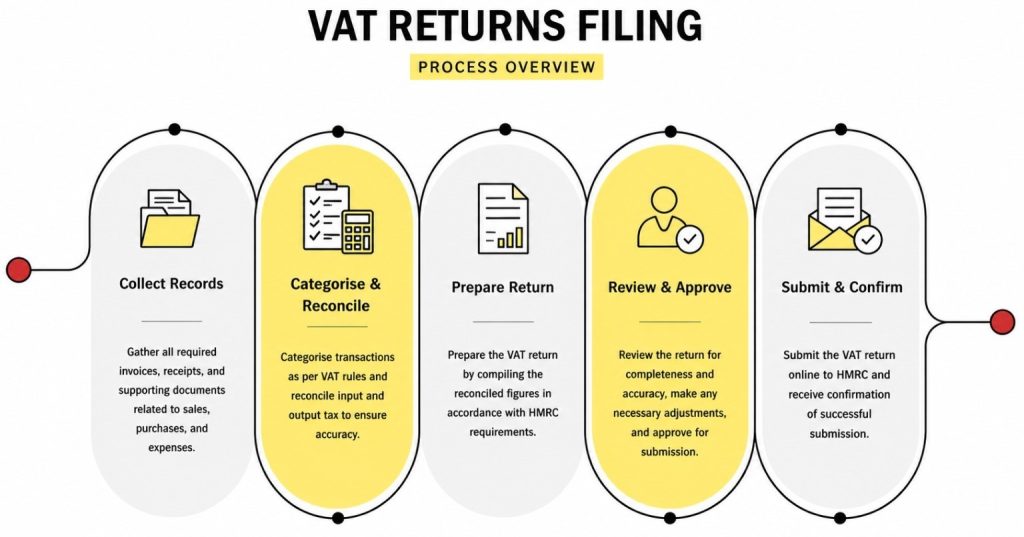
Outsourced VAT Returns: Built for UK Accountancy Firms and VAT-Registered Businesses
VAT compliance has become one of the most time-consuming areas of UK accounting practice. Between quarterly deadlines, Making Tax Digital record-keeping rules, and increasingly complex VAT schemes, in-house teams are stretched thin — particularly during peak filing periods.
VAT returns outsourcing is the practice of delegating VAT return preparation, reconciliation and HMRC VAT filing to a specialist back-office provider, while the accountancy firm or business retains full control of client relationships, sign-off and final submission decisions. It is not a replacement for your practice — it is additional capacity that works quietly behind the scenes.
UK businesses and accountancy firms increasingly turn to VAT outsourcing companies for three connected reasons. First, HMRC’s compliance requirements have tightened considerably since the rollout of Making Tax Digital, which now applies to all VAT-registered businesses regardless of turnover, requiring digital VAT records and submission through MTD-compatible software. Second, recruitment for experienced VAT professionals in the UK remains difficult and expensive, leaving firms short-staffed exactly when quarterly VAT deadlines cluster together. Third, the financial and reputational cost of getting VAT wrong — through HMRC penalties, penalty points, or late filing — is far higher than the cost of getting proper support in place.
E-Tech Consultancy & Services was built to solve this gap. We provide secure, efficient VAT return preparation services and back-office VAT support to ICAEW and ACCA practices, bookkeeping firms, SMEs, LLPs, contractors and e-commerce businesses across the UK. Our teams work inside your existing systems — Xero, QuickBooks, Sage, FreeAgent and more — under strict data security protocols, so your VAT returns are prepared accurately, reviewed thoroughly, and ready for submission well ahead of every HMRC deadline.
What Are VAT Returns?
A clear understanding of VAT reporting obligations is the foundation of good compliance. Here is what every UK business and accountancy firm needs to know.
Definition and Purpose
A VAT Return is a formal report submitted to HM Revenue & Customs, typically every quarter, that summarises the VAT a business has charged on its sales (output VAT) and the VAT it has paid on business purchases (input VAT). The difference between these two figures determines whether the business owes HMRC money or is entitled to a VAT refund. VAT reporting exists to ensure that VAT collected from customers on behalf of the government is accurately accounted for and passed on, or reclaimed correctly where input VAT exceeds output VAT.
Who Must Submit VAT Returns
Any business with taxable turnover exceeding the current VAT registration threshold of £90,000 in any rolling 12-month period must register for VAT and submit VAT Returns. Businesses below the threshold may also register voluntarily — often to reclaim input VAT or appear more credible to VAT-registered customers. Sole traders, partnerships, LLPs and limited companies are all subject to the same underlying rules once registered, although scheme choice and filing frequency can vary.
HMRC Requirements and Making Tax Digital (MTD)
Since the extension of Making Tax Digital (MTD) for VAT, every VAT-registered business — regardless of size — must keep digital VAT accounting records and submit VAT Returns using HMRC-recognised, MTD-compatible software. Transactions should flow into the software at the point of first entry, digital links must be maintained between systems, and spreadsheets alone are no longer sufficient without bridging software. Digital VAT records must generally be retained for at least five years, supporting HMRC's ability to review filings and reducing the risk of manual transcription errors.
VAT Calculations and Common Schemes
Depending on the nature and size of the business, VAT can be calculated under several schemes, including the Standard VAT Scheme, the Flat Rate Scheme, the Cash Accounting Scheme and the Annual Accounting Scheme. Each scheme has different rules for when VAT becomes due, how it is calculated, and what records must be kept. Getting the scheme — and the underlying VAT calculations — right is essential, since errors ripple through every subsequent return.
Our VAT Returns Back-Office Services
E-Tech Consultancy & Services delivers end-to-end VAT compliance services, covering every stage of the VAT lifecycle for accountancy firms and businesses.
VAT Return Preparation
Accurate preparation of VAT Returns from your source data, including sales and purchase ledgers, bank feeds and supporting documentation.
HMRC VAT Filing
Direct submission of completed returns through HMRC's VAT portal using MTD-compatible software, with confirmation and audit trail retained for your records.
Making Tax Digital Compliance
Full support transitioning clients onto digital VAT record-keeping, ensuring digital links, software compatibility and ongoing MTD compliance are maintained.
VAT Registration
Assessment of registration obligations, threshold monitoring, and preparation and submission of VAT registration applications to HMRC.
VAT Deregistration
Guidance and administrative handling when turnover falls below the deregistration threshold or a business ceases trading, including final VAT return preparation.
VAT Reconciliation
Reconciling VAT control accounts against submitted returns and underlying ledgers to catch discrepancies before they become compliance issues.
VAT Calculations
Precise calculation of output and input VAT across mixed-rate transactions, multiple schemes, and partially exempt activities.
VAT Adjustments
Correcting prior period errors, processing HMRC-permitted adjustments, and managing voluntary disclosures where required.
Reverse Charge VAT
Correct application of reverse charge rules for construction services, cross-border B2B services and other applicable transactions.
Partial Exemption Calculations
Managing partial exemption VAT calculations for businesses with both taxable and exempt supplies, including standard methods.
Import & Export VAT
Handling postponed VAT accounting, import VAT certificates, and export VAT documentation for international businesses.
EC Sales Lists
Preparation of EC Sales List reporting where applicable for businesses trading with EU counterparts under current post-Brexit rules.
VAT Audit Support
Preparing documentation, reconciliations and explanatory schedules to support HMRC VAT inspections and compliance checks.
VAT Record Maintenance
Ongoing digital record-keeping in line with MTD requirements, ensuring records are audit-ready and retained for required period.
VAT Advisory Support
Practical VAT advisory input on scheme selection, transaction treatment and compliance queries.
Quarterly VAT Returns
The most common filing frequency in the UK, fully managed end-to-end within your reporting calendar.
Monthly VAT Returns
Supporting businesses in a repayment position or with monthly filing obligations, with faster turnaround to protect cash flow.
Annual VAT Returns
Preparation under the Annual Accounting Scheme, including interim payment calculations and year-end balancing returns.
Benefits of Outsourcing VAT Returns
Reduced Operational Costs
Avoid the overheads of recruiting, training and retaining in-house staff
Expert VAT Professionals
Access specialists with deep UK VAT and HMRC compliance knowledge.
Faster Turnaround
Dedicated capacity means returns are completed well within deadline windows.
Accurate VAT Calculations
Structured review processes minimise costly calculation errors.
Better Compliance
MTD-aligned, HMRC-compliant processes reduce penalty risk.
Dedicated Offshore Teams
A consistent team that learns your clients and systems over time.
Business Continuity
Reduce reliance on individual staff members for critical VAT deadlines.
Increased Efficiency
Free up in-house teams to focus on advisory and client-facing work.
Better Client Satisfaction
Faster, more accurate VAT service strengthens client relationships.
Cloud Accounting Expertise
Teams fluent in the platforms your practice already uses.
Improved Reporting
Clear, transparent working papers for every VAT Return prepared.
Peace of Mind
Confidence that VAT deadlines and compliance are being handled properly.
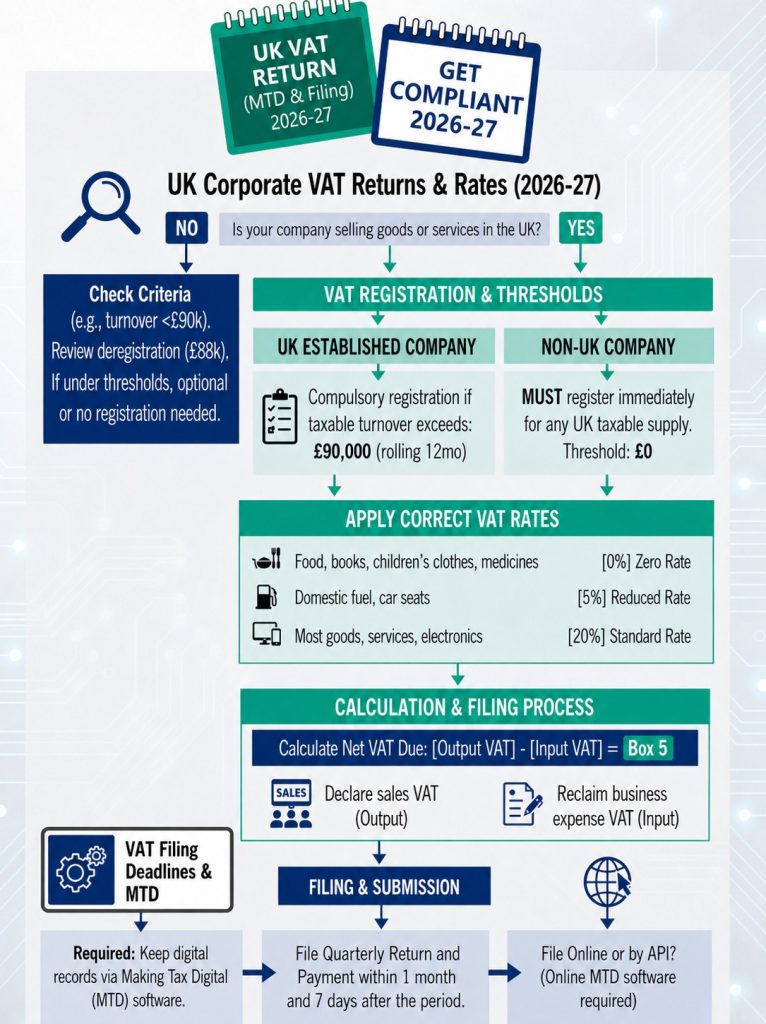
Problems we solve
VAT Compliance & HMRC Filings
Staying compliant means understanding registration, submission, digital record-keeping and payment obligations — and choosing the right VAT scheme for the business.
Core Compliance Areas
- Standard VAT Scheme
- Flat Rate Scheme
- Cash Accounting Scheme
- Annual Accounting Scheme
- Margin Scheme
The Comparison
VAT Deadlines & Filing Requirements
Missing a VAT deadline triggers HMRC penalties that compound quickly. The table below summarises key requirements.
| VAT Requirement | Deadline | Importance |
|---|---|---|
| VAT Registration | Within 30 days of exceeding the £90,000 rolling 12-month threshold | Late registration can trigger backdated VAT liability and penalties |
| Quarterly VAT Returns | One calendar month and 7 days after the end of the VAT period | Most common filing cycle; late submission adds penalty points |
| Monthly VAT Returns | One calendar month and 7 days after each monthly period | Applies to repayment traders; delays affect refund cash flow |
| Annual Accounting Scheme | Two months after the annual period end, with interim payments during the year | Missed interim payments can trigger scheme withdrawal |
| VAT Payments | Same deadline as the associated return, unless a Direct Debit payment plan applies | Late payment triggers separate penalties and daily interest |
| MTD Compliance | Ongoing — from first VAT period after registration | Non-compliant record-keeping risks HMRC enquiry |
| Digital Record Keeping | Continuous, maintained in MTD-compatible software | Manual/spreadsheet-only records are not compliant without bridging software |
| Record Retention | Minimum 5 years from the relevant filing date | Required for HMRC inspection and audit readiness |
FAQs
Frequently Asked Questions
A VAT Return is a periodic report submitted to HMRC summarising output VAT charged on sales and input VAT paid on purchases, with the balance either paid to HMRC or reclaimed.
Any business registered for VAT, including those exceeding the £90,000 taxable turnover threshold or voluntarily registered, must submit VAT Returns for each period.
MTD is HMRC's requirement for VAT-registered businesses to keep digital records and file VAT Returns using MTD-compatible software, replacing manual and spreadsheet-only processes.
Yes. We prepare and can submit VAT Returns directly through MTD-compatible software under your authorisation, or return completed returns for your own submission.
We support the Standard VAT Scheme, Flat Rate Scheme, Cash Accounting Scheme, Annual Accounting Scheme and Margin Scheme, along with partial exemption calculations.
We work within Xero, QuickBooks, Sage, FreeAgent, AutoEntry, TaxCalc and Excel, matching whatever platform your practice or business already uses.
Yes, we regularly support accountancy firms and group structures managing several VAT registrations across different entities.
Data is transferred through encrypted channels and handled under strict confidentiality agreements, with access limited to assigned team members only.
Yes, including postponed VAT accounting, import VAT certificates and export documentation for internationally trading businesses.
We prepare reconciliations, working papers and supporting schedules to help you respond confidently to HMRC compliance checks and audits.