
Why cost tracking and allocation matter
Understanding where your money goes is essential to protecting profitability and keeping your business financially resilient. Accurate cost tracking and allocation help you identify spending patterns and understand the true cost of delivering each product, service or project.
By assigning direct and shared costs appropriately, you gain a clearer view of which activities generate value and where margins are under pressure. This supports better pricing, realistic budgets and more informed decisions about resources. Regular reviews also highlight unexpected changes and practical ways to reduce waste while maintaining service quality.
Better cost visibility
See where money goes across departments, projects and products.
Improved profitability
Find and close the cost leaks that quietly erode margins.
Accurate product costing
Know the true cost of producing or delivering each product and service.
Smarter pricing
Set prices from real cost data rather than estimates.
Stronger budget management
Compare planned and actual spending, and correct course early.
Department accountability
Hold cost centres responsible for their own budget performance.
Reduced waste
Cut unnecessary and duplicated spending.
Data-driven decisions
Base strategic choices on verified financial data.
Our services
| Service | What It Covers |
|---|---|
| Cost tracking | Real-time recording of direct and indirect costs, materials, labour and vendors |
| Cost allocation | Fair distribution of shared costs such as rent, utilities and support services |
| Cost centre accounting | Department-level setup, monitoring, KPIs and profitability |
| Project cost tracking | Budget monitoring, labour, materials, contractors and variance analysis |
| Activity-based costing | Costs assigned by the activities that drive them |
| Overhead allocation | Factory, administrative and selling overheads with a defensible method |
| Budget vs actual analysis | Variance analysis, cost control reports and forecast adjustments |
| Fixed and variable analysis | Cost behaviour, contribution margin, break-even and profit planning |
Track Costs, Strengthen Your Margins
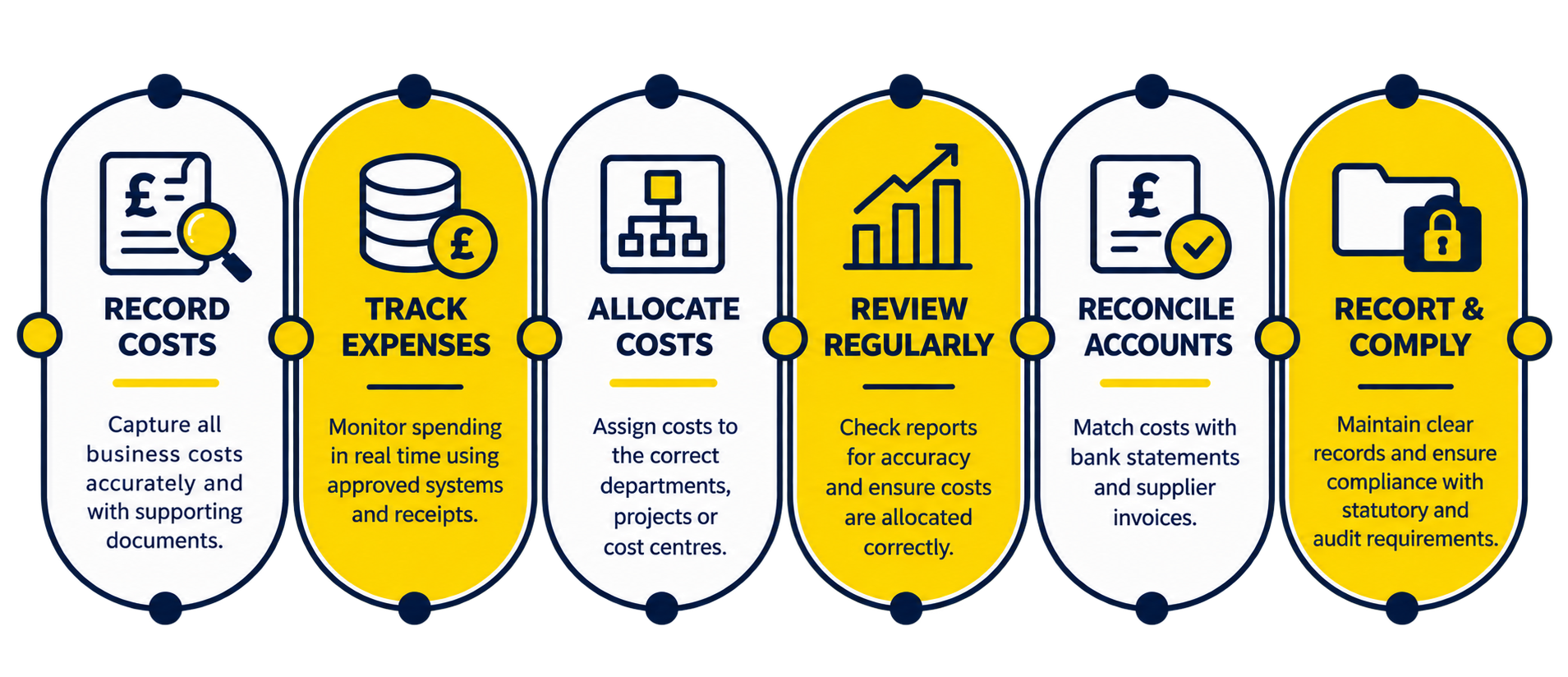
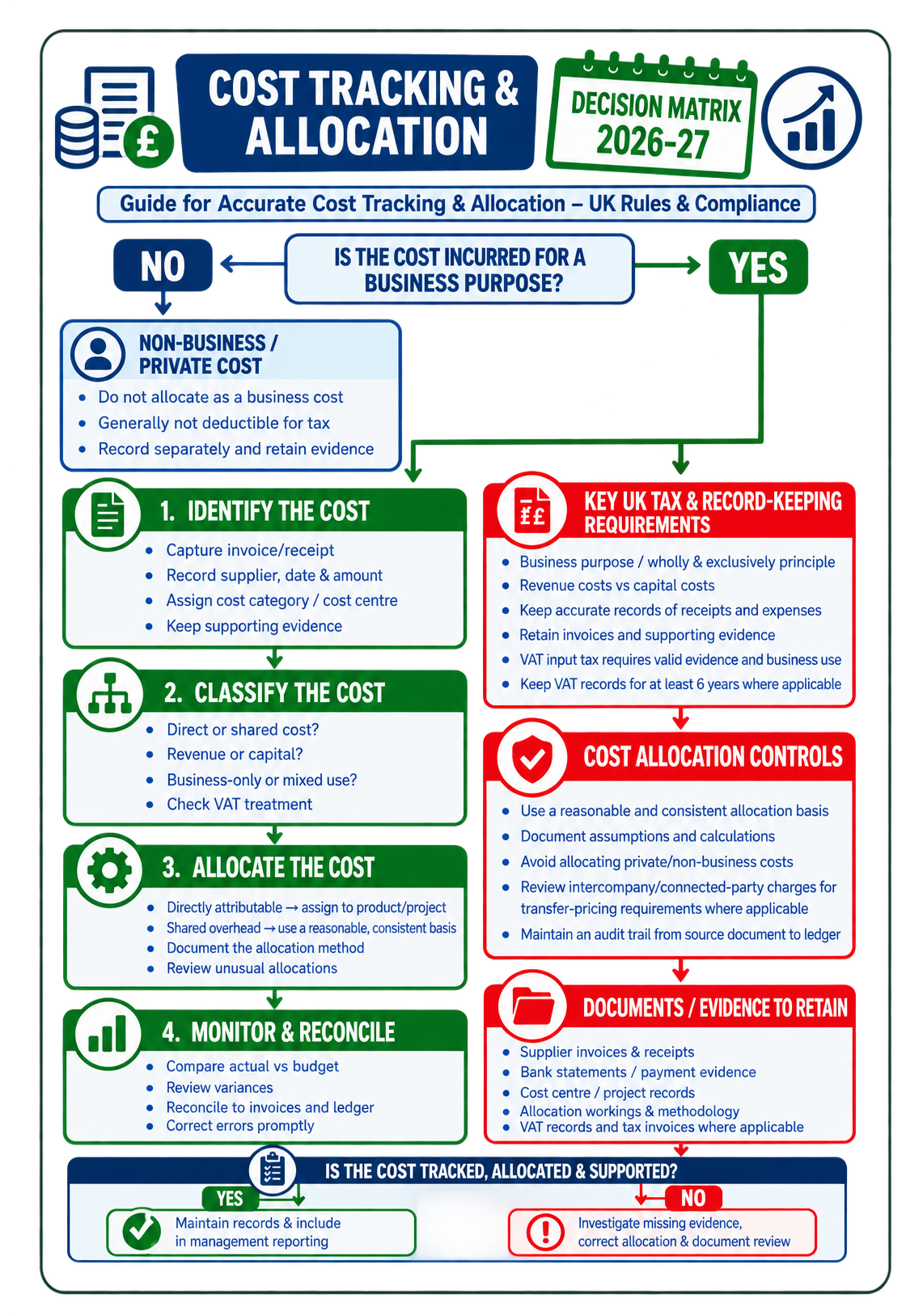
Our cost tracking and allocation support helps businesses understand expenditure, maintain reliable records and assign costs to the right activities. We capture supplier details, amounts and supporting documents, distinguish business spending from private costs, and classify expenses by type. Direct costs are assigned to relevant projects, while shared overheads follow consistent allocation methods. This gives you a clear and consistent picture of what each department, project, product or service really costs to run, rather than relying on rough estimates. With costs recorded accurately from the start, you spend less time correcting errors later and more time using the figures to run your business.
We compare actual spending against budgets, review variances and reconcile invoices with ledger entries. Our team also checks allocation methods, documents adjustments and maintains supporting evidence, including receipts, bank statements and project records. By reviewing unusual transactions and resolving missing information, we help improve reporting accuracy and visibility over expenditure. This structured approach supports informed pricing, realistic budgeting and better decisions about resources, efficiency and business profitability. Because records are organised and well documented, your reports are easier to trust, easier to explain and ready when you need them for management reviews, lenders or your accountant. Any differences between planned and actual figures are explained clearly, so you understand not just what changed but why.
We also look at how your costs behave, separating fixed and variable expenses so you can understand contribution margins and break-even points. With these insights, you can see where margins are under pressure, spot costs that are rising without explanation and decide where savings can be made without affecting the quality of your service.
Common challenges we solve
- Leadership can’t see where money is being spent
- Departments and projects regularly exceed budgets
- Operating costs rise each year without clear explanation
- Spending lacks structured monitoring and control
- Product costs are estimated rather than calculated
- Prices are set without a reliable view of true cost
- Spreadsheet reports are slow, error-prone and late
Frequently Asked Questions
Let’s Discuss Your Requirements
Have a question about our services? Speak with our team to discuss your engagement, deadlines and the support you need.
What Is Cost Tracking?
Cost tracking means recording and monitoring your business spending, by category, project or department, so you can control budgets, price accurately and improve profitability.
What Is Cost Allocation?
Cost allocation is the process of dividing a business’s costs between the departments, projects, products, services or clients that use them. Some costs belong clearly to one area, such as a project’s materials. Others are shared, such as rent, utilities, software or management time, and need to be split fairly. Allocation gives each area its share, so you can see what it really costs to run.
Why Is Cost Centre Accounting Important?
Cost centre accounting tracks costs by department, team, location or function, so you can see where money is being spent and who is responsible for it. Without it, costs sit in one large pool, which makes it hard to tell which parts of the business are efficient and which are overspending.
What Is Activity-Based Costing?
ABC assigns overhead based on the activities and cost drivers that consume resources, giving more accurate product and customer profitability.
Can you Create Executive Dashboards?
Yes. We build executive dashboards that give leaders an at-a-glance view of KPIs, finances and project status, tailored to your business.
How do you Decide how to Allocate Shared Overheads?
We choose a method that is fair, consistent and easy to defend, for example allocating by headcount, floor space, hours worked or revenue. We check the method regularly and document any adjustments.
What Is a Break-Even Point, and why does It Matter?
It is the level of sales at which your total income equals your total costs. Knowing it helps you set realistic sales targets, price your products or services properly and judge the risk of taking on new costs.
Why Is It Important to Separate Business and Private Spending?
Mixing the two leads to inaccurate records and can cause problems with tax reporting. Keeping them separate gives you reliable figures and supports compliance.