
What are M&A support services?
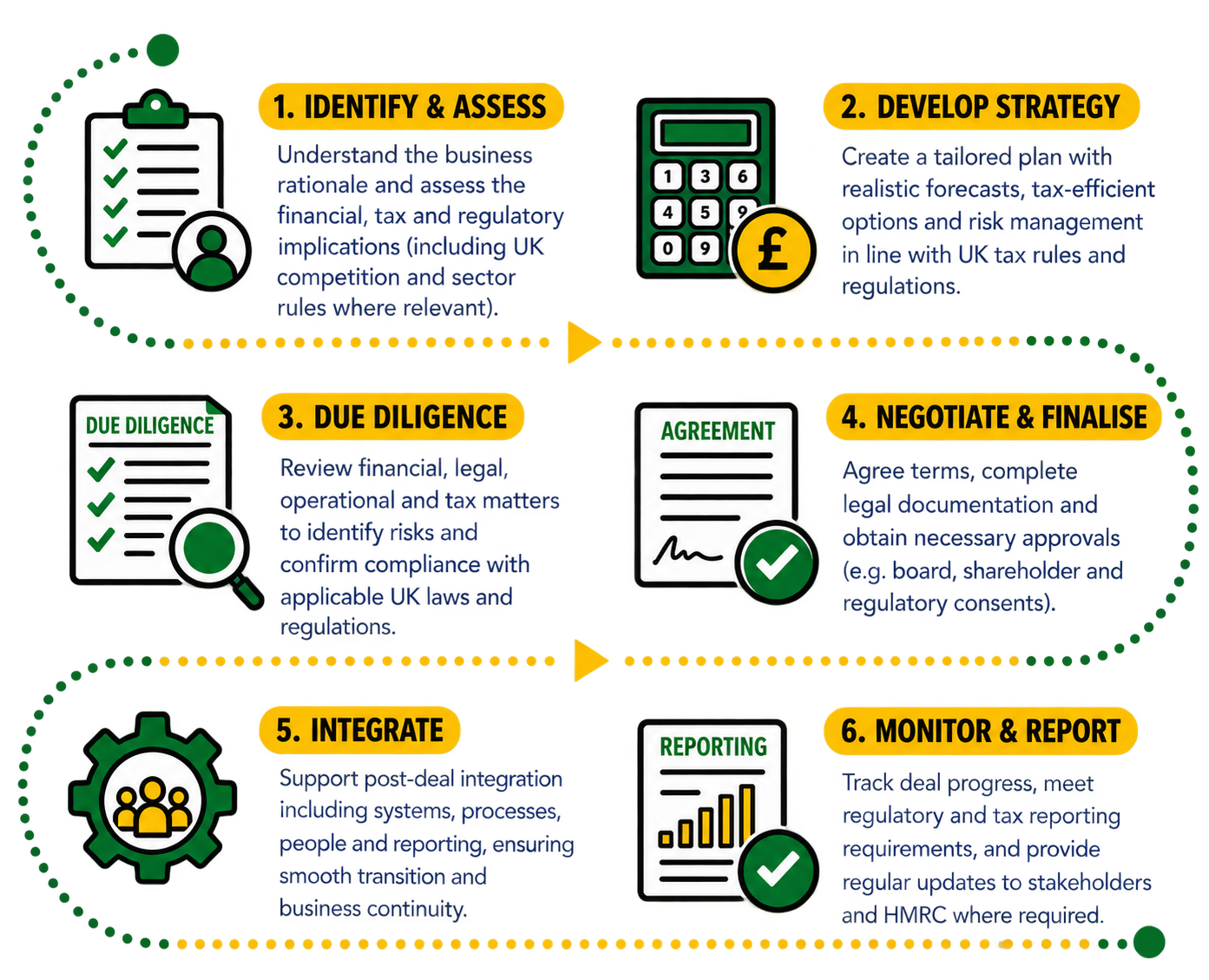
M&A support services help businesses manage mergers, acquisitions and sales throughout the transaction process, from identifying suitable opportunities to completing the deal. These services include financial analysis, business valuation, due diligence and deal structuring to support informed decision-making. A well-managed process helps you understand what a business is really worth, what risks come with it and whether the deal fits your long-term goals. It also helps you negotiate with confidence, based on facts rather than assumptions.
We help you evaluate potential targets, identify financial and tax risks, negotiate favourable terms and protect business value. Whether you are buying, selling or merging a business, our support helps ensure a smoother transaction and prepares you for successful post-deal integration and future growth. Working alongside your advisers, we organise financial information, review transaction assumptions and coordinate outstanding queries, helping maintain clear communication, realistic expectations and an organised approach at each stage of the process, from initial discussions through to final completion. Keeping the financial side of the deal well documented also helps reduce delays and avoid surprises along the way.
Good preparation can make a significant difference to the outcome. For sellers, well-organised financial records and clear supporting information help build buyer confidence and keep negotiations on track. For buyers, thorough analysis helps you avoid overpaying and plan how the new business will fit with your own. Once the deal is signed, we can also support integration of systems, teams and processes, and track whether the expected benefits are being achieved, so you can stay focused on the decisions that matter most.
Our services
M&A advisory
Strategic guidance for buyers and sellers, from opportunity assessment to closing.
Financial due diligence
Earnings quality, debt, cash flow and internal controls checked before you commit capital.
Commercial due diligence
Independent review of market position, customers, suppliers and growth sustainability.
Business valuation
DCF, comparable company, precedent transaction, asset-based and EBITDA methods.
Deal structuring
Share or asset purchases, financing, earn-outs and payment terms designed for efficiency.
Financial modelling
Integrated, scenario and sensitivity models, plus synergy and return analysis.
Risk assessment
Financial, market, legal, tax, cybersecurity, ESG and integration risk.
Post-merger integration
Systems, teams, processes and KPIs after closing, with synergy tracking.
We also provide purchase price allocation and M&A tax structuring, including tax due diligence, capital gains, stamp duty and VAT planning.
Materials we help assemble
- Historical financial statements
- Working capital schedule
- Debt and liability summary
- Customer concentration report
- Tax filings (three years)
- Corporate governance documents
Frequently Asked Questions
Let’s Discuss Your Requirements
Have a question about our services? Speak with our team to discuss your engagement, deadlines and the support you need.
Why Is Financial Due Diligence Important?
In M&A, financial due diligence is important because it verifies the target’s earnings and cash flow, supports a fair valuation, identifies debt and hidden liabilities, and shapes deal terms and protections, so the buyer avoids overpaying or inheriting unexpected risks.
How are Businesses Valued?
Businesses are commonly valued by combining several methods: DCF (present value of forecast cash flows), comparable companies (peer multiples), precedent transactions (multiples from past deals, including control premium), EBITDA multiples (industry multiple applied to normalized EBITDA), and asset-based valuation (adjusted net assets). Using several methods cross-checks the result and gives a defensible value range.
How Long does an Acquisition Take?
Most acquisitions take three to twelve months, depending on deal size, due diligence and funding. We’ll give you a clearer timeline once we understand your plans.
How can Tax Structuring Improve an Acquisition?
Tax structuring helps reduce the tax cost of a deal by choosing the right structure, using available reliefs and spotting hidden liabilities early. Planning it before terms are agreed gives the best result.
Do you Support Both Buyers and Sellers?
Yes. We support both buyers and sellers, helping with financial review, deal structure and preparation from first discussions through to completion.
What Is an Earn-Out?
An earn-out is part of the purchase price that is paid later, depending on how the business performs after the sale. It can help bridge differences in price expectations between buyer and seller.
What Is Financial Modelling in an M&A Transaction?
We build integrated, scenario and sensitivity models, plus synergy and return analysis, so you can test assumptions and understand how different outcomes could affect the value of the deal.
What Risks do you Assess?
We review financial, market, legal, tax, cybersecurity, ESG and integration risks, so potential problems are identified before you finalise the transaction.